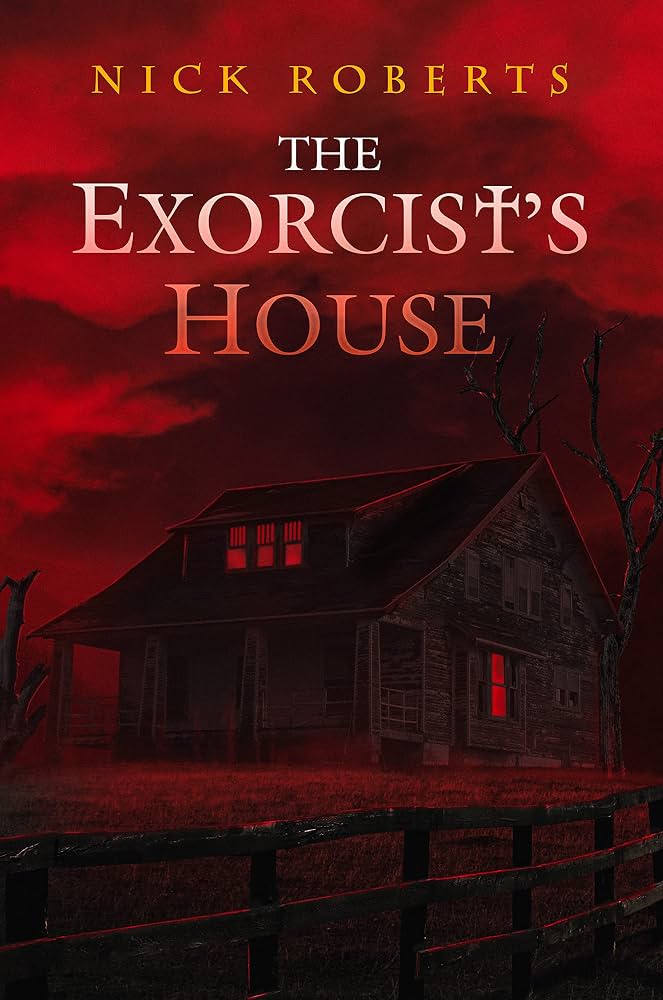
Nick Roberts’ The Exorcist’s House is a fun idea, and it’s filled with little nods to the genre and the tropes, particularly William Peter Blatty’s original novel The Exorcist. But for all that, it seems to be a popcorn horror book. It’s fun, though some of it feels like it goes a little too far in a B-movie way, and sadly, once it’s over, it’s easily let go of.
It’s entertainment, and hopefully that’s how Roberts meant it. It goes a little too far on the demons in our world angle when it could have been a more frightening, is-it-all-in-your-mind? kind of thing.
The Hills have bought a new house (Hill House), which they plan to renovate and flip. Unfortunately, the house has a very dark past. A self-made Exorcist, Merle Blattty (see above), made his last stand there, dying in his own home, as he succumbed to demonic forces that haunt the mind.
The family, Daniel, Nora and daughter Alice, move in, and odd things promptly start happening: strange visions and encounters, and Daniel, the patriarch, explores the creepy basement and secret room and well attached to it (shades of Amityville).
Each one begins to fall prey to the forces at work in the house, and none of them are telling the others. There is lots of non-communication and bad decisions, a hallmark of the genre.
And there is a gateway to capital ‘h’ Hell in the basement, and things are coming through.
Can the family be saved?
Roberts does have some really good sequences in the book, and some of them can be really spooky, but then, I feel, he always takes it a step too far, showing the whole monster instead of letting it lurk in the shadows of our imagination.
Honestly, as I closed in the climax and a final confrontation is underway, I couldn’t help but think of the stop-motion demon, Sardo Numspa, from The Golden Child. I wanted something a little darker and unnerving; what I got was a popcorn film.
And if that’s your jam, you’re bound to enjoy it. It even insists on giving you one last scare before the end of the book, though it’s telegraphed.
This, by no means, is a bad book, but it does not signal a change in the guard for the genre. It’s a fun romp that entertains, but never quite hits the truly scary mark. Though, as I said, there are a couple of truly unnerving sequences.
I’m also sure there are tons of references that I may have missed or that were intimated, and those I did enjoy coming across.
So if you’re looking for a refresher between books, this one may do the job. I loved the idea, and I’m going to hunt down more of Roberts’ work, but it didn’t completely wow me. Popcorn.