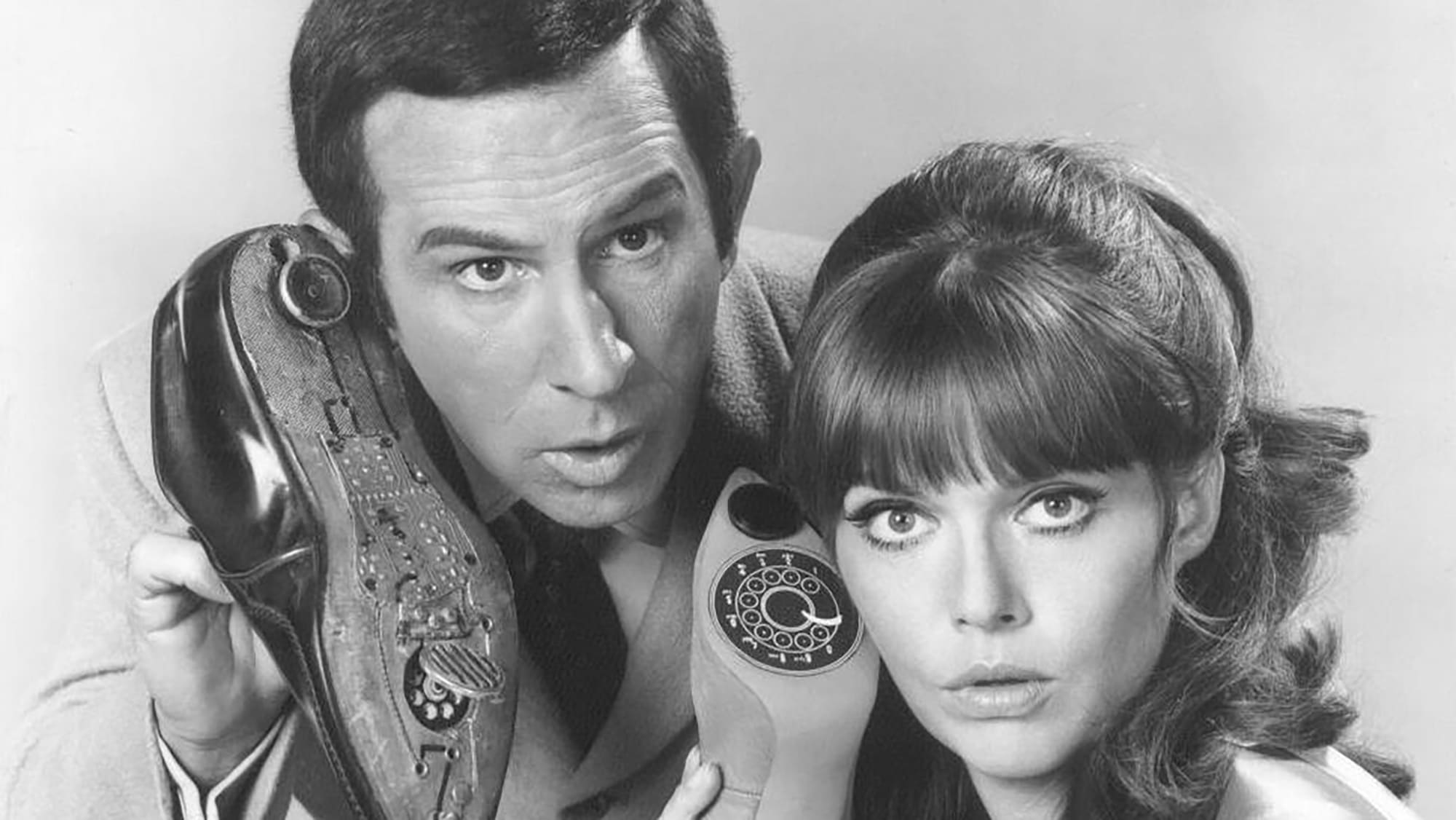
In the 1960s, spies were everywhere! They were in novels, comics, on the big screen, and had spread to television. Created by Mel Brooks and Buck Henry, Get Smart debuted on 18 September, 1965 and introduced us to CONTROL’s agent 86, Maxwell Smart (Don Adams).
Filled with goofy gadgets, like the shoe phone, Smart is a haphazard spy in the vein of 007. In the pilot episode, Mr. Big (written by Brooks and Henry), Smart gets his latest assignment.
Mr. Big (Micheal Dunn) is planning on blowing up the Statue of Liberty with the Inferno weapon that he’s stolen from Professor Dante (Vito Scotti). Mr. Big works for Smart’s version of SPECTRE, KAOS . Smart has to go after him, and his aided by Agent 99 (Barbara Feldon) and Agent K13 – aka Fang.
Chief of Control (Edward Platt) delivers the assignment and outfits Smart with gadgets. There are sight gags, lots of physical humor, and gadget… like the cone of silence.
This is the only episode shot in black and white, and it served as the series pilot. Did it and the series need a laugh track? I say no, because damn, this one is funny. It plays with already established tropes like gadgets, romance, capture by the villain, bad girls, monologuing and ending up in a boat at the climax.
It’s easy to see that his was going to be a great series from the get-go, it plays with everything we’ve come to expect from spy movies of the time, and does it with lots of laughs.
Smart leaps into color with the Diplomat’s Daughter. Written by Gerald Gardner and Dee Caruso, this was first broadcast on 25 September, 1965.
Smart is assigned to look after Princess (Inger Stratton), a diplomat’s daughter, after a number of blondes go missing. In the course of protecting her, Smart stumbles across a KAOS plot, and tangles with The Claw (Leonard Strong).
It seems the Asian arm of KAOS has a plan for them. Sadly this episode is a little racist, but there’s still a lot to enjoy in this episode. There are gadgets aplenty, of course, tailored specifically for the needs of the story.
Adams is proving himself incredibly likable in the role, and knows how to play to the comedic nature of the plot while still conveying the suaveness that is expected from International Man of Mystery.
And, of course, Princess just wants to have fun, and that includes wanting some alone time with Max as she runs all over swinging Washington.
But poor 99, her outfit for this episode is absolutely horrible.
The series is comedic, but not quite the camp that Batman would reach. It’s early in the series, so it’s still finding its feet, but this episode doesn’t work quite as well as Mr. Big.
There are some fun gags, and the wrist radio is a nice touch, but the racism in this episode is pretty horrible, including Strong’s ‘accent’ as he pretends to be Asian.
Context has to be taken into account, sure, but it’ s a little jarring and disappointing.

School Days was written by Stan Burns and Mike Marmer. It debuted on 2 October, 1965. It opens with a great sequence of Smart meeting his contacts, and ending up in the wrong place.
He and 86 are going undercover at the local CONTROL spy school to root out a KAOS agent. 86 is posing as a teacher, while Smart is a trainee. There is a nice upping of the romantic tension between the two. It’s a lot of fun.
Fang shows up to help. He’s undercover too.
They’ll all work together to figure out who the impostor is, but there are more than a couple of options, and it’s going to take tons of effort to figure out who the baddie is.
Smart has a car phone in his Sunbeam Tiger MK I roadster, and that must have seemed amazing.
And there are a couple of gadgets in this episode that are direct lifts from James Bond. The wrist watch garrote featured in From Russia With Love, and Oddball’s bowler from Goldfinger. They are used as training tools.
It’s a funny episode, and considering how prevalent spy film and television was, it’s no surprise that it was a success. I’ll be eager to continue my exploration of the series and see the nods, homages, and how things change over the years.


 The Mind Reels