I remember being completely enchanted when I realized the movie, Hugo, was not only about a boy who lived in a train station, but about Georges Melies, the famed French director, and his wonderful collection of films. It absolutely swept me up in it’s narrative.
But I had never read Brian Selznick’s original book, which is a beautiful and hefty tome, filled with an cinematic drawings to bring sequences to life, and some of Melies’ own drawings and film stills.
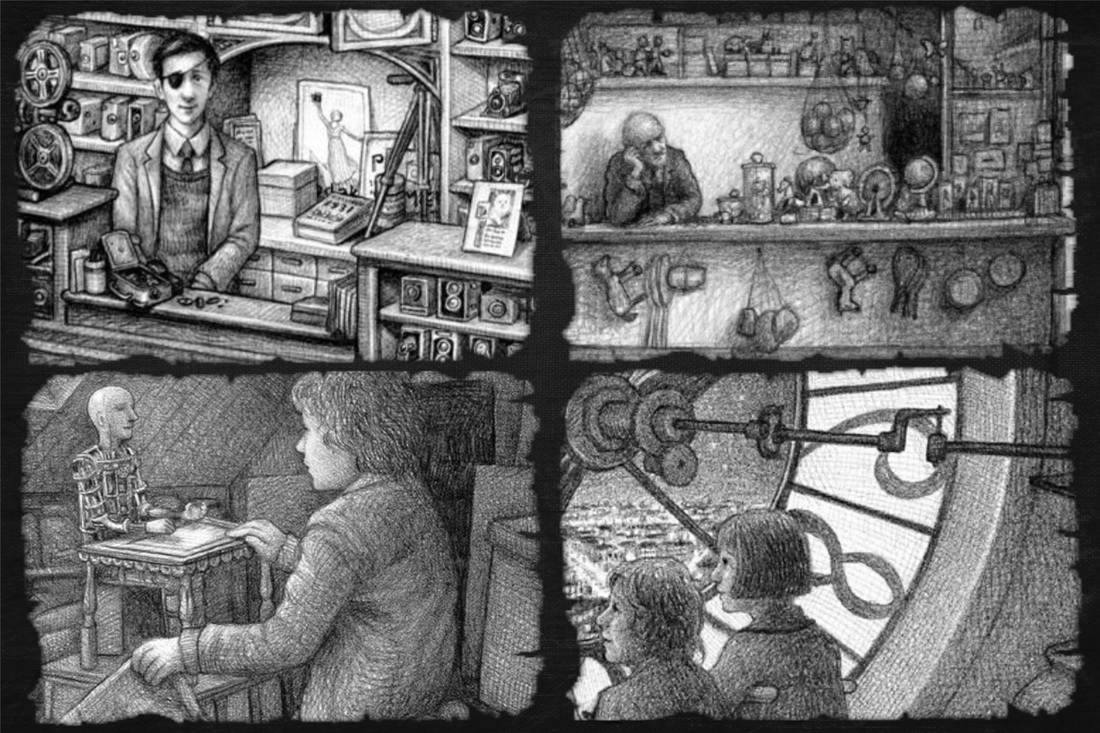
I found it just as engaging as I did it’s film adaptation. The story is a little different, but all of the pieces are there, working together to tell its narrative about a boy, Hugo, who lives in the massive Parisian train station, keeping all of its clocks running, and stealing bits of food to get by, and mechanical toys for parts.
He runs afoul of the toymaker, after one too many thefts, and the toymaker’s goddaughter, Isabelle , who refers to her godfather as Papa Georges.
In his tiny hidden apartment in the station, Hugo has an automata, a mechanism of gears and cogs made to look like a man that can write a message, only if Hugo can repair it and find the key to wind it. His father was working on it at the museum when he died in a fire. Hugo reclaimed the automata, and has been working on it, fixating on it, believing it must have a message for him from his father.
But then, how can Isabelle have the key?
It’s a fun little mystery, that anyone can see coming from a mile away, but Selznick tells such a magical tale, filled with fantastic drawings, that you are swept up in it immediately. And the mystery of the automata is only the first half of the book.
Once Hugo and Isabelle receive the automata’s message, it opens up a whole new mystery for the pair of them, and it dives into Melies wonderful, and much loved work. Melies was in fact a magician turned film maker when he saw the new medium, and his imagination conjured countless cinematic journeys.
But when the Great War happened, things fell apart, his debts became too massive, and to get by, he really did work in a toy ship on the Montparnasse train station, until he was rediscovered, and yes, he did create automata which had been given to a museum.
Sure, Hugo’s narrative is fictional, and Selznick’s interpretation of Melies’ character is also fictional, but it is none the less a great story, and ties in nicely with established historical record. And it’s no wonder Scorsese wanted to make the film version, the book, it’s format, and and its story all lend themselves to the silver screen, but the book was just as captivating.
And Selznick’s art is absolutely wonderful. A great read, and an oh so wonderful reminder of the magic of film in general, and Georges Melies speciffically. Loved it!


 The Mind Reels