
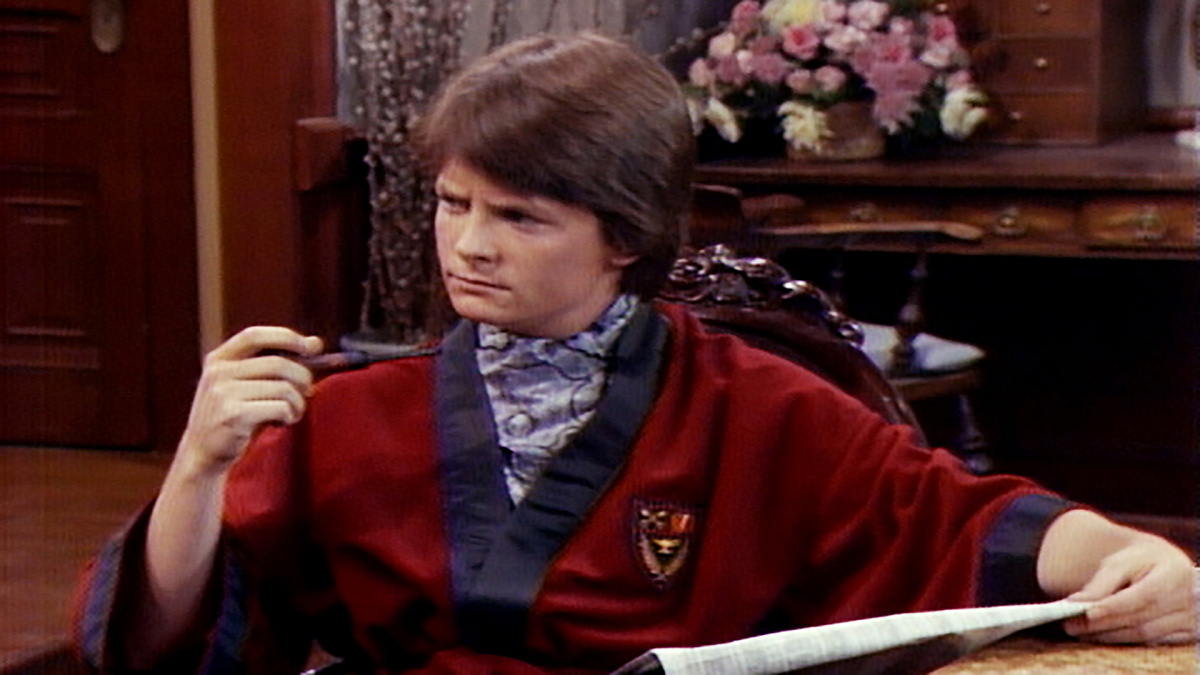
Michael J. Weithorn wrote Summer of ’82 which first debuted on 27 October, 1982. Alex (Micheal J. Fox) is working his job at the local grocery store, Adler’s Grocery, and doing deliveries with Jennifer (Tina Yothers) when he meets Stephanie (Amy Steel) and loses his heart.
But it’s not only his heart he loses when he connects with Stephanie who is working on her economic senior thesis. She asks him out to an economics seminar, and they become romantically and sexually involved.
It’s Alex’s first time and he becomes very attached to her. But despite his plans that spring up immediately after the ‘pivotal event,’ Alex is hurt and troubled to find that Stephanie has a date with someone who is not him the next day.
There is some discussion in the Keaton household about whether or not it’s acceptable for Alex to be dating a college girl, and Mallory (Justine Bateman) points out the double standard that she’s not allowed to date college boys.
And it also deals with the concept of losing one’s virginity, how it can mean so much to one party, and not mean as much to the other. It doesn’t make a judgment call on whether or not Alex is too young or not to have a sexual relationship, it presents it as a matter-of-fact thing that happens, and Steven (Micheal Gross), Alex’s father, deals with it incredibly well, with humour and sensitivity.
In fact, the entire episode deals with its sensitivity and laughs, and once again, probably generated a lot of conversations for some viewers.
I Never Killed for My Father was written by Kimberly Hill and first aired on 3 November, 1982.
Sons and their fathers don’t always get along, and so when Steven’s father, Jake (John Randolph), shows up at the Keaton household for a visit, it’s no surprise that they clash over everything. It really doesn’t help that Jake is not only set in his ways, but is a very staunch Republican, and Steven and Elyse (Meredith Baxter) are dedicated Democrats.
Through the clashing and the fighting, Jake finally reveals that this will be his last visit because he’s very sick. He’s dying.
Steven has to come to terms with the news, and the fact that his relationship with his father has always been strained, and wonders if it is too late to make any form of amends?
After more arguments over perspectives, politics and more, Steven reveals he just wanted to spend time with his father and have his father recognize that Steven can have his own opinions and still be his son. They also struggle with admitting that they love one another, and after they both admit it, they know they’ll have differing opinions but struggle to be honest, and emotionally available for one another.
The themes resonate, and once again, the series deals with very important themes while making them accessible, a little funny, worth talking about and wrapping them up inside a twenty-minute window.
Not everyone is going to be able to do that, but if it opens up the opportunity to start a dialogue, then that must be a good thing.

Give Your Uncle Arthur a Kiss keeps the serious subject matter coming. Written by Lloyd Garver and series creator Gary David Goldberg this episode debuted on 10 November, 1982, and puts Mallory in a really uncomfortable place.
It seems family friend, ‘Uncle’ Arthur (David Spielberg), makes an unwanted overture towards Mallory, and she has to figure out how to deal with it, and what it means, even as her father prepares a farewell tribute for Arthur at the local public television station that they work at.
After Arthur makes his move, Mallory turns to Alex for advice and support, and instead of Alex supporting his sister, he deflects it, refusing to believe Arthur could do such a thing, that Mallory obviously misinterpreted things.
Things get really creepy when Arthur ‘apologizes’ and then makes things worse by sexually assaulting her by forcing a kiss on her.
Mallory, in her way, tries to signal her family that something happened, but after her encounter with Alex, she keeps quiet and sullen. But she turns to Alex again for help, and this time he comes to his sister’s support and brings Elyse into things.
The conversation between Mallory and Elyse is smart, well-written and confronts the topic head-on, dealing with the concept of victim-blaming, and the guilt, embarrassment and fear that Mallory feels.
Elyse confronts Arthur, and reveals it to Steven on-air!
The pair confront Arthur, and they seem a helluva lot more forgiving than I think I would have been (and sure Arthur apologizes to Mallory and realizes he needs help, but he’s a bad person and needs to leave the Keatons alone, especially Mallory). But it’s a smart, well-written episode, and once again deals with some serious subject matter and makes it accessible.
A brilliant show.


 The Mind Reels