Xu Haofeng, an accomplished fight choreographer, writer and director and first-time director Xu Junfeng delivers a period piece set in 1920s China, specifically, Tianjin, where the master of a wushu academy has just died and has passed on its leadership to his apprentice, Quan Qi (Andy On) instead of his son, Shen An (Jacky Heung) setting up a bitter rivalry amidst rumours of a fourth form taught only to family members.
The 1920s are evoked lovingly by the production design, and the story has a heightened sense of melodrama that works with the almost stylized form of storytelling that the directors dole out.
When Quan’s leadership style and plans don’t mesh with the circle of trainers who form the academy, they are willing to give him a chance, but his constant pursuit of a fourth form and confrontations with An cause him to be ousted. This allows Quan to dominate the final half of the film as he constantly pressures An to fight and show him this fabled short sabre form that is rumoured to be the family’s last secret.
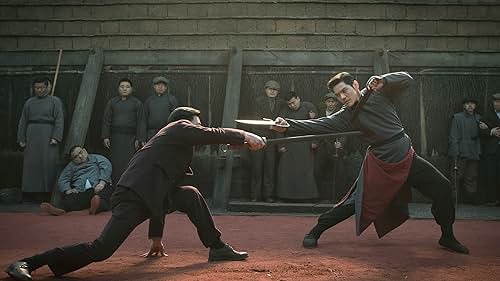
The fights flow as smoothly as the constantly moving camera, while still buried in the reality of the scene and the narrative. Each duel and fight tells a story.
The melodrama flows from the character behaviours and some of the dialogue. It’s not quite over-the-top, but it doesn’t have a heightened sense of drama giving the story a bit of theatricality.
But let’s be honest, with Haofeng’s name attached to a film viewers are coming to see the choreography and fight sequences, and how they all play out on the screen. There is the heightened sound, the clash of steel, and whish of fabric as fists fly, and weapons meet.
Occasionally the pacing seems a little off, but that may be more of a translation from Eastern to Western storytelling, overall, 100 Yards is a solid entry into the martial arts film genre, has a story to engage most viewers and has some lightning-fast choreography to entertain fans.

 The Mind Reels